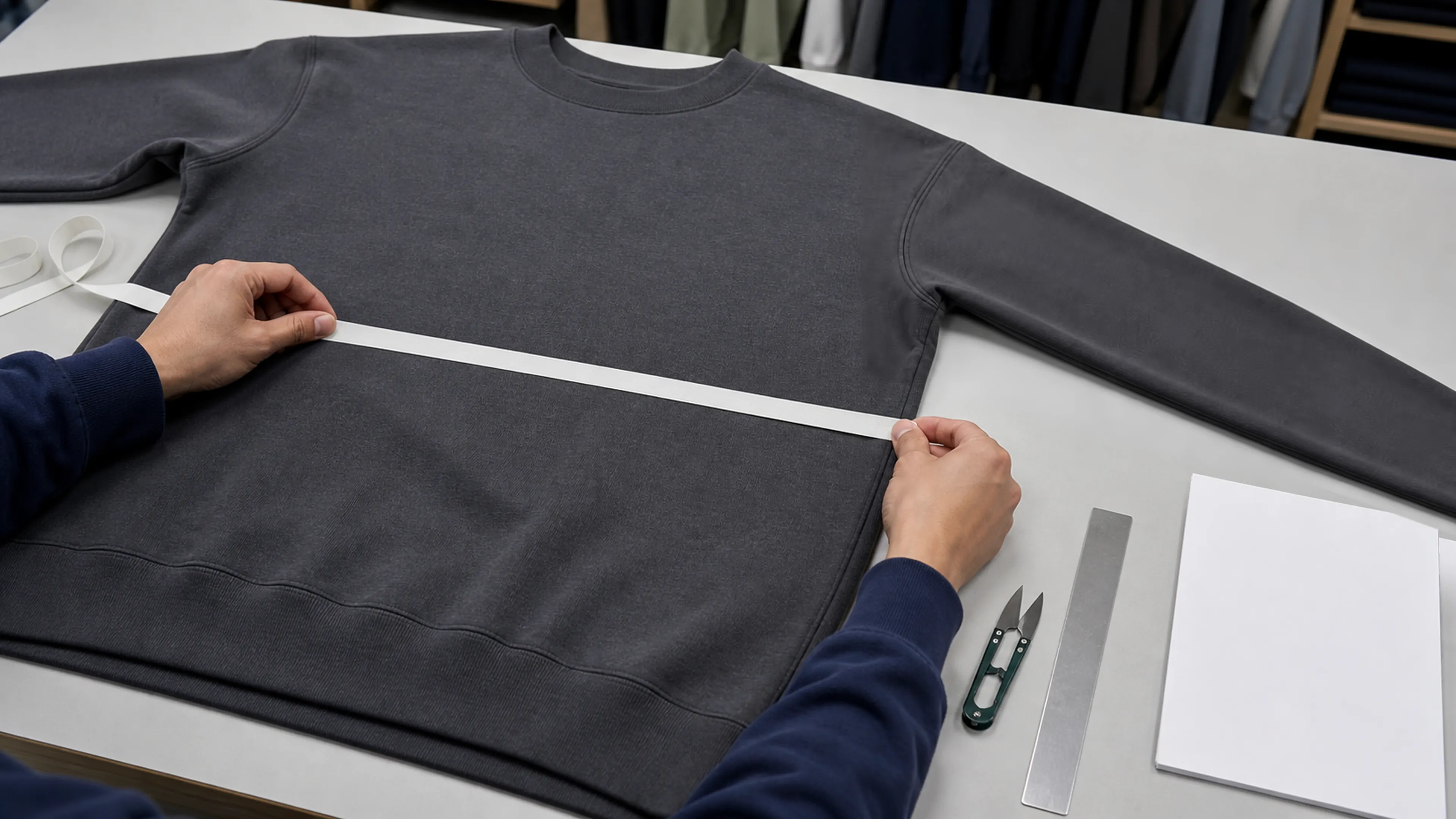
Use a garment inspection checklist to define approved references, in-line checks, final garment review, packing release and traceable decisions.
A garment inspection checklist connects the order to an approved sample, specification and clear release decision. It helps buyers and production teams review the same evidence at the right stage. It does not guarantee zero defects, replace product testing or establish market compliance by itself.
Define the inspection scope before checking garments
Write the inspection plan before production is complete. The plan should identify the order and product, the references that control the review, the stage being checked and the person authorised to make the decision.
| Record before inspection | What to state | Why it matters |
|---|---|---|
| Product and order scope | Style or SKU, colour, size range, order or lot reference and quantity in scope | Prevents results from being applied to a different product or lot |
| Approved references | Named physical sample, specification revision, measurement chart, artwork, colour standard and packing instructions | Establishes what the inspector is comparing |
| Inspection stage | Material, pre-production, in-line, finishing, final garment or packing release | Keeps one stage from being treated as approval of every later stage |
| Selection method | Which units, sizes, colours and cartons will be checked and how they are selected | Makes the result reviewable rather than anecdotal |
| Acceptance rules | Project-defined defect descriptions, measurement tolerances and decision rule | Separates an observation from a release decision |
| Responsibility | Who inspects, reviews findings, authorises rework and releases the order | Prevents an unclear pass from moving forward without ownership |
If the project uses a formal sampling standard or an agreed acceptance-quality plan, record the exact standard, lot size, inspection level and acceptance numbers in the project documentation. Do not add an AQL number to a checklist without confirming what it controls and how the sample size will be calculated.
Confirm readiness before in-line inspection
An in-line check is more useful when the controlling references are already available. Confirm that the correct material, approved colour direction, trims, labels, artwork revision and construction instructions have been issued to the production stage being reviewed.
Record any open approval separately. A pending wash result, unresolved label file or unapproved artwork colour should not disappear inside a general quality note. If an open item affects production already under way, record who will decide whether work pauses, continues at risk or is separated for later review.
Use in-line checks to find process issues early
In-line inspection should focus on issues that can still be corrected before the order reaches final packing. The checkpoints depend on the garment, but a practical review can include:
| Checkpoint | Compare | Record |
|---|---|---|
| Material and colour | Approved fabric, shade direction, surface, panels, ribs and trims | Units or bundles checked, visible variation and affected scope |
| Cutting and assembly | Grain or nap direction, panel matching, operation sequence and component placement | Repeated construction issue, location and required correction |
| Sewing workmanship | Seam type, stitch appearance, skipped or broken stitches, puckering, raw edges and thread condition | Defect description, frequency, photos and rework decision |
| Measurements | Agreed points of measure and tolerance on the specified garment condition | Size, measured values, result and measurement method |
| Decoration | Correct artwork revision, size, placement, colour direction, surface and garment distortion | Sample reference, affected units and disposition |
| Labels and trims | Correct version, position, attachment, orientation and visible condition | Component code or version and any mismatch found |
Inspection frequency is project-specific. A complex garment, a new operation or a repeated issue may justify a different check pattern from a stable repeat programme. The checklist should show why attention changed instead of implying that one fixed frequency suits every order.
Final garment inspection checklist
Use the accepted garment and written specification together. Check a planned selection across the relevant sizes, colours and packing units rather than choosing only the easiest garments to reach.
- Confirm the style, colour, size and order identifiers on the garment and inspection record.
- Compare overall silhouette, balance and visible appearance with the approved sample.
- Measure the agreed points in the stated garment condition and record actual values.
- Inspect seams, stitches, hems, necklines, cuffs, waistbands, pockets, closures and reinforcement points relevant to the style.
- Check for holes, cuts, stains, oil, marks, shade issues, fabric faults, loose threads and damage from pressing or finishing.
- Confirm buttons, snaps, zips, drawcords, elastic, hardware and other trims are correct, secure and usable.
- Compare print, embroidery or other decoration with the approved artwork and physical sample for version, placement, colour direction and visible condition.
- Confirm brand, size, care and other labels use the approved files and appear in the approved positions.
- Check hangtags, stickers and other product-information components against the SKU plan.
- Confirm folding, individual presentation, assortment and carton instructions against the approved packing brief.
- Record every finding with enough detail to locate the affected garment, size, colour or carton.
- State the decision and required next action: release, hold, sort, rework, replace, reinspect or escalate for review.
Separate packing release from garment inspection
A finished garment can meet workmanship requirements and still be packed under the wrong SKU, size ratio or label version. Packing release should therefore reconcile the garment, product information and carton plan as a separate step.
Check the approved fold, individual bag or protective method, hangtag and sticker versions, barcode or SKU mapping, size and colour assortment, carton quantity, carton marks and any destination-specific instructions supplied for the order. Legal, carrier and market requirements need the appropriate project review; a visual packing check does not prove regulatory compliance.
Classify findings with project-defined language
Terms such as critical, major and minor are useful only when the project defines them. Describe the observable condition, its location and why it affects safety, function, saleability, appearance or agreed specification. Then apply the agreed classification and decision rule.
Avoid vague notes such as “bad sewing” or “colour wrong”. A useful record names the seam or panel, the expected reference, the observed condition, how many checked units were affected and what action was taken. Photos should include an overall garment view and a close detail when both are needed to locate the issue.
Keep a traceable inspection record
The final record should include the inspection date and location, order and lot scope, references and revisions used, units or cartons checked, measurement results, findings, photographs, rework or sorting action, reinspection result and named release decision.
Keep the approved sample and the inspection record connected to the repeat-order file. A later order may use the record as context, but it still needs confirmation that the garment, material, artwork, labels, packing and acceptance rules have not changed.
For the production context behind these checkpoints, review the garment quality control process. When the product itself is still being developed, use the clothing sample approval checklist before treating the garment as the production reference.
Information to send before quality review
Provide the style or SKU, quantity by colour and size, destination, approved sample identity, current specification, measurement chart and tolerances, artwork and decoration approvals, label and packing files, required inspection stage, selection method, acceptance rules and decision contacts. Mark unresolved items clearly so the inspection result is not asked to approve information that was never supplied.