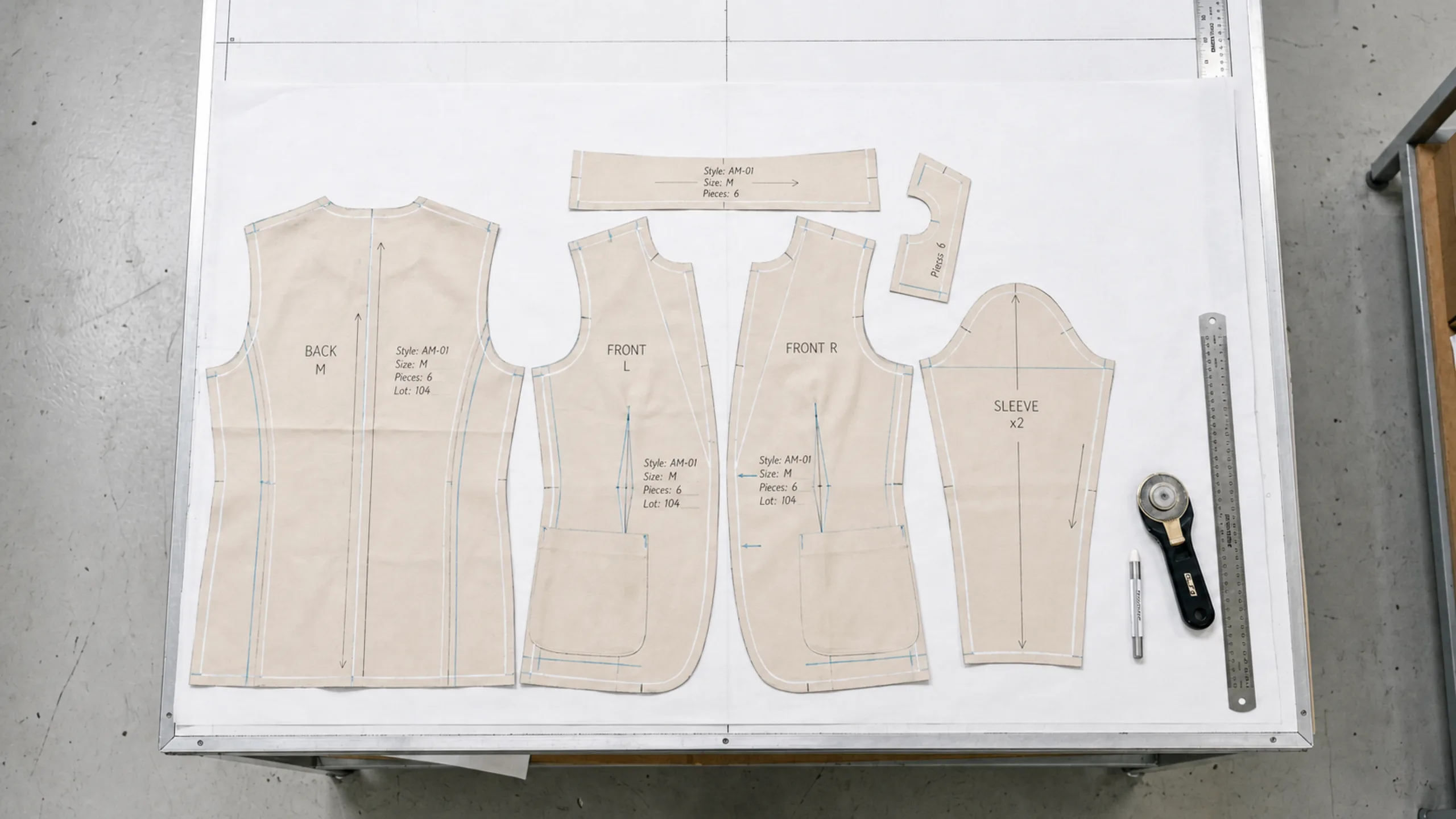
Compare customization of a developed blank with full cut-and-sew manufacturing, including fit control, sampling, development and project complexity.
Blank apparel customization and full custom garment development can both produce a branded garment, but they solve different product problems. In this guide, “cut-and-sew” means developing the garment itself for the project; it does not simply mean that a garment is sewn. The key question is which parts of the garment must change for the brief to work.
The difference in one table
| Decision | Blank apparel customization | Full cut-and-sew manufacturing |
|---|---|---|
| Base fit and pattern | Chosen from a developed garment | Developed for the project |
| Fabric and construction | Largely fixed by the selected blank | Selected and engineered with the design |
| Typical brand changes | Print, embroidery, labels, hangtags and packaging | Fit, fabric, pattern, panels, seams, trims, wash and decoration |
| Sample focus | Garment choice and branding result | Fit, measurements, construction, materials and branding |
| Development workload | Lower when the blank already meets the brief | Higher because the garment itself must be resolved |
| Best starting evidence | A physical blank and final artwork | Sketches, references, measurements or a tech pack |
The table is a planning guide, not a promise about MOQ, price or timing. Those depend on the actual garment, materials, colours, decoration, quantity and approval scope.
Choose blank apparel customization when the garment already works
A developed blank is useful when its silhouette, measurements, fabric, project-confirmed colour options and construction are already close to the intended product. The development effort can then focus on the identity added to that garment.
This route commonly fits:
- branded T-shirts, hoodies and sweatshirts based on an approved style;
- company, event, team or merchandise programmes;
- print or embroidery projects where fit is not being redesigned;
- project-confirmed private-label details such as label application, hangtags and packaging;
- repeat programmes that need a recorded garment and decoration reference.
Start by browsing the relevant blank apparel categories. Compare fit, fabric composition, GSM, size range and the colour options confirmed for the project before adapting artwork. A decoration method should be tested on the selected garment, because the same logo can behave differently on jersey, fleece, rib, seams or coated surfaces.
Choose full custom manufacturing when the garment must change
Full custom development is appropriate when an existing blank cannot carry the product idea without compromise. The route can define original measurements, pattern pieces, fabric, panels, pockets, seams, rib, closures, trims, wash and finishing.
Use the full custom clothing manufacturing route when the brief requires one or more of the following:
- a proprietary silhouette or measurement set;
- a fabric construction, colour process or hand feel not available in a blank;
- original panel lines, pockets, hoods, collars, closures or garment engineering;
- branding that must be applied before assembly or integrated into construction;
- a coordinated range that depends on shared custom materials and trims.
Full custom does not remove the need for clear approvals. It usually increases the number of product decisions that must be recorded before bulk production.
Compare the cost of unresolved decisions, not only the unit price
A blank can reduce pattern and material development, but it becomes inefficient if buyers keep trying to force an unsuitable style to match an original design. Full custom can justify more development when the garment itself creates the product value, but it is unnecessary if a developed blank already meets the brief.
Before requesting a quote, identify which requirements are fixed and which are preferences. For example, “an oversized T-shirt” is open to interpretation; “a specified half-chest, body length, shoulder and sleeve relationship” is a clearer fit requirement.
Sampling and approval are different on each route
For blank customization, review the actual garment, colour, artwork version, decoration placement, label application and packing presentation. The selected blank remains the base reference.
For cut-and-sew, review fit, measurements, pattern balance, construction, materials and trims before treating decoration as approved. Revisions should be named and dated so comments refer to the correct sample.
A useful approval record states what was reviewed, which sample or artwork version was accepted, and which tolerances or changes remain open.
A route-selection checklist
Answer these questions before choosing:
- Does an existing garment already meet the required fit and size range?
- Must the fabric, panels or construction be original?
- Can the decoration be applied cleanly to the finished blank?
- Does branding need to be integrated before garment assembly?
- Which physical sample will become the approval reference?
- Are quantity, destination market and target timing stated as ranges rather than assumptions?
If the first answer is yes and most changes are decorative, review blank apparel customization. If fit, material or construction must be developed, prepare a full custom brief instead.
Information to send with an enquiry
Provide the garment category, reference images or sketches, intended use, quantity range, destination, target timing and all non-negotiable details. Add artwork dimensions and placement if branding already exists. For original garments, use the clothing tech pack guide to make open decisions visible before sampling.